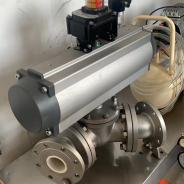
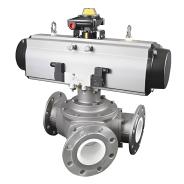
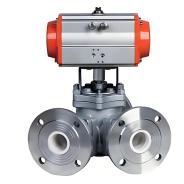
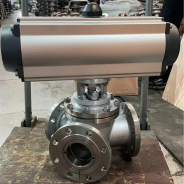
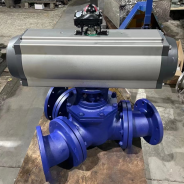
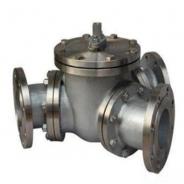
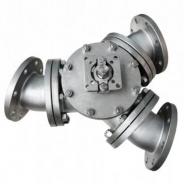
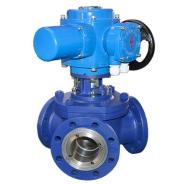
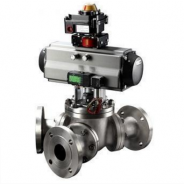
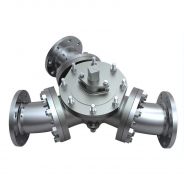
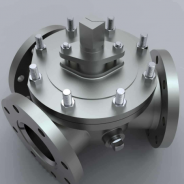
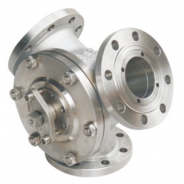
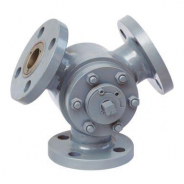
3 way Y type ball valve Core Structural Composition and Design Characteristics
The 3 way Y type ball valve features a compact overall structure, reasonable layout and convenient disassembly and maintenance. It consists of six core parts: valve body assembly, ball core, valve stem transmission assembly, sealing assembly, driving actuator and packing sealing assembly. With high structural stability, strong resistance to pressure fluctuation and jamming-free opening and closing, it is suitable for long-term continuous automatic operation.
1 Valve Body Structure
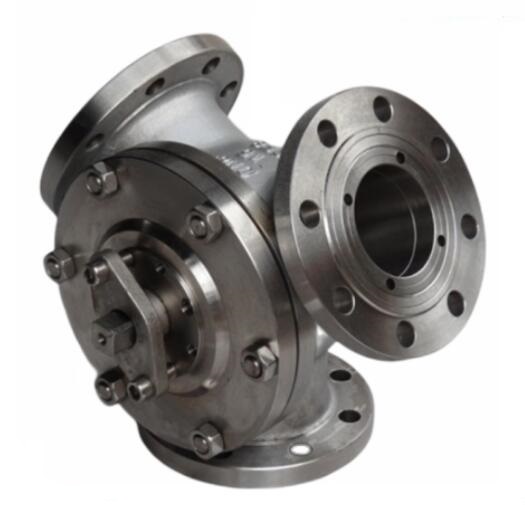
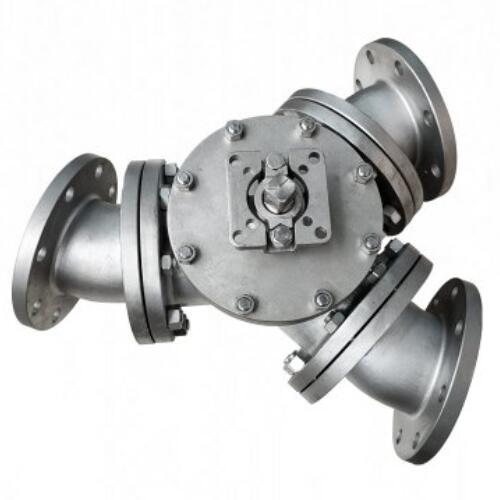
The 3 way Y type ball valve body is formed by integral forging or precision casting. Optional materials include WCB carbon steel, 304 stainless steel, 316L stainless steel, duplex steel and more, adapting to normal temperature, high temperature, low temperature, slight corrosion and other working conditions. Adopting an integrated Y-type three-way layout, the valve body has a smooth inner flow passage without concave and convex dead corners, effectively reducing fluid scouring wear and medium adhesion accumulation. It supports multiple connection modes such as flange, thread and welding, meeting the installation requirements of various industrial pipelines with strong universality. The mainstream structures are top-mounted and side-mounted. The top-mounted structure allows on-line maintenance of internal parts without pipeline disassembly, offering higher operation and maintenance convenience.
2 Ball Body and Flow Passage Design
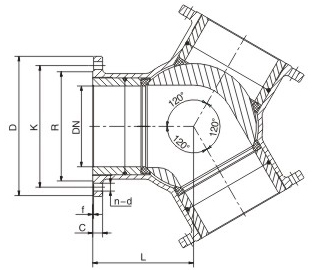
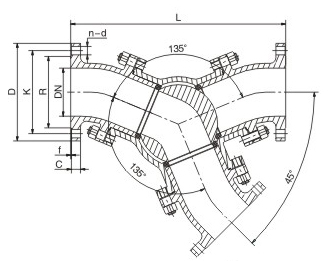
As the core control component, the ball body adopts a solid precision ball structure with high strength, excellent impact resistance and non-deformation performance. The internal flow passages strictly correspond to the Y-type angle of the valve body, divided into two mainstream types: 120° equal flow passage and 135° inclined flow passage. The 120° structure is suitable for equal three-way flow diversion and confluence working conditions with uniform and stable flow distribution. The 135° structure focuses on straight-through large-flow conveying and bypass switching, with straight-through flow resistance close to that of straight-through ball valves, which is more suitable for main pipeline large-flow and bypass fine switching scenarios. The ball flow passage is precisely polished with large flow coefficient and low pressure loss, delivering far higher medium conveying efficiency than traditional three-way valves.
3 Sealing System Design
The 3 way Y type ball valve supports dual soft and hard sealing systems, fully covering high and low temperature, high and low pressure, clean and particle-containing medium working conditions. The soft seal adopts enhanced PTFE and polyphenylene sulfide sealing materials, featuring good sealing toughness and high fitting accuracy, realizing zero leakage under normal temperature and adapting to clean water, gas, oil products, clean chemical media and other particle-free clean media. The hard seal adopts Stellite alloy surfacing and supersonic tungsten-cobalt alloy spraying on the ball surface, with the sealing surface hardness reaching above HRC60. It is resistant to scouring, high temperature and wear, capable of withstanding high temperature, high pressure and micro-particle media, with long-term stable sealing performance without attenuation.
4 Valve Stem and Anti-Leakage Structure
The Y type ball valve stem adopts an integral forged stainless steel structure, featuring high strength, torsion resistance and corrosion resistance, with no offset or fracture risk during opening and closing. The valve stem packing area adopts a multi-layer flexible packing and external leakage prevention sealing design, matched with thrust gaskets and dustproof structures, which effectively prevents medium leakage and dust intrusion, improves the sealing performance and service life of the valve, and adapts to automatic operation scenarios with frequent opening and closing.
3 way Y type ball valve Installation, Operation and Daily Maintenance
1 Installation Specifications
Thoroughly clean welding slag, impurities and dust inside the pipeline before installation to prevent hard particles from scratching the sealing surface and ball flow passage. Install the valve strictly in accordance with the medium flow direction mark on the 3 way Y type ball valve body; it supports multi-angle installation including horizontal and vertical without direction limitation. Tighten flange bolts evenly to ensure uniform fitting of the sealing surface and avoid leakage caused by offset pressure. After the installation of automatic valves, conduct no-load commissioning of opening, closing and switching actions to confirm jamming-free and accurate switching before formal operation.
2 Operation Requirements
Perform opening, closing and reversing operations gently and uniformly; violent sudden opening and closing is prohibited to reduce instantaneous fluid impact loss on the sealing structure. Overpressure, overtemperature and over-rated working condition operation is forbidden to prevent component deformation and sealing failure. Regularly flush the pipeline when conveying easily crystallized, viscous and powder media to avoid micro-residue accumulation. Calibrate the opening accuracy of automatic valves regularly to ensure precise diversion and regulation.
3 Daily Maintenance
3 way Y type ball valve features low failure rate and simple maintenance. Daily inspection only needs to check the valve body sealing state, driving mechanism operation condition, wiring and air source stability. For long-term idle equipment, perform reciprocating no-load opening and closing before restarting to clean internal micro-residues. Regularly inspect the aging state of sealing parts for soft-seal valves and the wear state of sealing surfaces for hard-seal valves. Unauthorized disassembly of precision sealing components is prohibited to avoid reduced fitting accuracy and sealing performance attenuation. The overall maintenance workload is small, suitable for long-term unattended continuous industrial operation.
 info@shxvalve.com