China Ball valve manufacturer,factory and supplier-Ball valve
 info@shxvalve.com info@shxvalve.com

Mobile:+86-17717520739
Wechat:17717520739
Email:info@shxvalve.com
Address: NO.720, Suide Road, Jiading District,Shanghai, China.


2026-07-11
Four way ball valve is known as two-way four-way rotary valve, one valve can be a valve to achieve positive and negative water supply switch, every turn 90℃, water supply mode switch once, before the need for four valves, valve 1, 4 open, valve 2, 3 closed;When reverse water supply valve 2, 3 open, valve 1, 4 close, now use a four-way ball valve to replace, easy to operate.
Four way ball valve is suitable for circulation system of liquid, gas, slurry and solid particle medium.Four way ball valve is used to replace the working principle of the manifold and valve group, which simplifies the procedure, facilitates the operation, reduces the cost, facilitates the control and has good synchronization
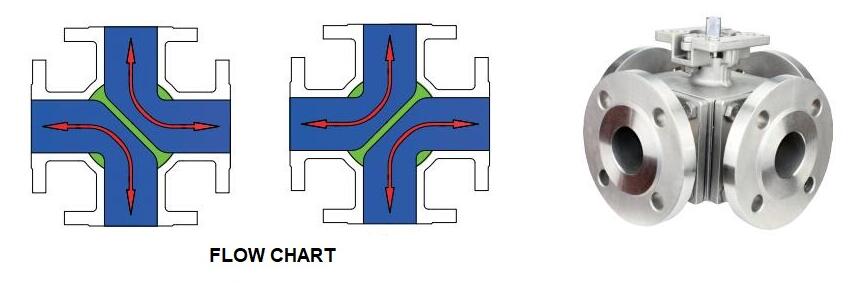
Four way ball valve has an L / T / X (Double L) / Straight Shaped Port Hole through the middle for suitable service condition. The different combinations of flow are shown in the figure. T Port Four way ball valve connect any three ports, L Port Four way ball valve connect any two side right angle port, X Port Four way ball valve in side have two L Shaped Port in the ball that do not interconnect, it is also called as X Port Ball Valve. We also offering Four way ball valve with either Pneumatic or Electrical actuator operated for automation.
Four way ball valve is a core special industrial valve with integrated flow diversion, merging, and direction switching functions. As an upgraded multi-functional fluid control device developed based on standard two-way and three-way ball valves, Four way ball valve features a unique four-port single-valve structure. By rotating 90 degrees, the valve completes fluid direction switching, medium diversion, and cyclic commutation, which greatly simplifies pipeline layout, reduces the number of pipeline accessories, lowers system energy consumption, and minimizes failure risks. Four way ball valve is widely applied in petroleum and chemical industries, power stations, HVAC systems, metallurgy and mining, water treatment, and light industrial slurry systems, four-way ball valves are essential equipment in modern automated fluid control systems.
With the core advantages of simplified structure, multi-function integration, low flow loss, zero leakage, wide adaptability and long service life, Four way ball valve solves the pain points of cumbersome structure, high failure rate, high energy consumption and difficult maintenance of traditional multi-valve combined pipeline systems. Its precise 90-degree commutation and multi-mode fluid control capability perfectly adapt to various industrial fluid switching, diversion and circulation working conditions, optimizing pipeline system structure, reducing equipment investment and operation and maintenance costs, and improving the automation, stability and efficiency of industrial production. As an energy-saving multi-functional fluid control valve, the 4 way ball valve has become the preferred product for pipeline upgrading and equipment supporting in various industries, with high engineering application value and market popularity.
| Product Name | Four way ball valve |
| 1. Material | SS304/316/304L/316L ( CF8/CF8M/CF3/CF3M),etc. |
| 2. Size | 1/2~16 inch ( DN15~DN400) |
| 3. Port | 4 way Port |
| 4. Working Pressure | 150LB~600LB |
| 5. Connection Ends | Flange,threaded end or others |
| 6. Working Temp. | -29~180℃,-40~450℃ or according to customer requirements for different industry. |
| 7. Suitable Medium | Water, Natural Gas, Oil and some corrosive liquid |
| 8. Operation | Handle operated, Locking device is option |
| 9. Inspection & Testing | According to API598,JB/T9092 |
Four way ball valves can be used in oil, natural gas, coal and ore mining, refining and processing and pipeline transportation system;In the production of chemical products, medicine and food;In hydroelectric, thermal and nuclear power generation systems;In the water and drainage, heating and gas supply systems of urban and industrial enterprises;In the drainage and irrigation system of farmland;4 way ball valve is an important mechanical product closely related to production construction, national defense construction and people's life.4 way ball valve is used in all kinds of pipeline systems to cut off or connect the medium flow, so that the medium is transported to each designated point in accordance with a predetermined program.
Four way ball valve adopts an integrated forged or cast structure with compact overall dimensions. Four way ball valve mainly consists of a valve body, ball core, seat sealing assembly, valve stem, packing sealing unit, driving actuator, and position indicator. All components cooperate precisely to ensure long-term stable operation.
1. Valve Body
As the main pressure-bearing component, the valve body is integrally cast or forged without welding gaps, delivering excellent pressure resistance. Common materials include carbon steel, austenitic stainless steel, martensitic stainless steel, and alloy steel, adapting to water, oil, steam, acid-base corrosive media, and particle-containing slurry. The four ports of the Four way ball valve are arranged in a cross symmetrical layout with optional flange, thread, and welding connections. Four way ball valve body high structural rigidity, impact resistance and deformation resistance, the valve body adapts to complex working conditions with variable pressure and temperature ranges.
2. Ball Core
The precision-machined solid ball core is the key control component. Its surface is hardened, polished and anti-rust treated to reduce sealing wear effectively. There are two mainstream flow channel types for Four way ball valve: X-type andL-type. X-type flow channels enable cross commutation and pairwise intercommunication of four ports, suitable for bidirectional circulation and alternate feeding systems. L-type flow channels realize right-angle commutation, on-off control and flow diversion, ideal for pipeline switching and medium distribution working conditions. The ball core material matches the valve body, providing outstanding corrosion resistance, scour resistance and fatigue resistance for extended service life.
3 Sealing System
Four way ball valves are equipped with soft seal and hard seal structures to meet diverse working conditions. Soft seals adopt PTFE, reinforced nylon and special engineering plastics, achieving complete zero leakage under normal temperature and low pressure clean medium conditions. With self-lubricating properties, soft seals ensure flexible operation and low wear. Hard seals adopt hard alloy surfacing and precision lapping technology, featuring high temperature resistance, high pressure resistance, scour resistance and wear resistance. They are applicable to harsh working conditions such as high-temperature steam, high-pressure oil, and particle-containing media. Meanwhile, the valve stem adopts a double-layer packing sealing structure to prevent external medium leakage, with sealing performance improved synchronously as medium pressure increases.
4 Valve Stem & Transmission Structure
The Four way ball valve stem is integrally forged from high-strength stainless steel with no stress concentration, possessing excellent torsion resistance and fracture resistance. It only performs 90-degree rotational motion without axial displacement, which greatly reduces packing wear and external leakage risks. The tenon-type anti-drop connection between the valve stem and ball core ensures gap-free accurate transmission, avoiding jamming and slipping and guaranteeing precise commutation accuracy.
5 Driving & Indication Device
The Four way ball valve supports manual, pneumatic, electric and hydraulic driving modes, adapting to on-site manual operation and remote automatic control. Equipped with a high-precision opening indicator, it directly displays the valve operating state and rotation angle. The matching limit locking device fixes the valve position stably to prevent offset caused by working condition fluctuations, supporting linkage control with automatic systems and upper computer intelligent regulation.
Four way ball valve have two flow direction: X port and L port as below:
X type Four way Ball Valve: Realizes four-port cross commutation and pairwise intercommunication, supporting bidirectional medium circulation and dual-channel alternate conveying, which is the preferred choice for pipeline circulation and bidirectional water supply systems.
L Port Four Way Ball Valve: Completes right-angle commutation, single-channel on-off and flow diversion with stable switching logic, suitable for pipeline switching, medium distribution and standby pipeline switching working conditions.
(L port) structure and flow direction: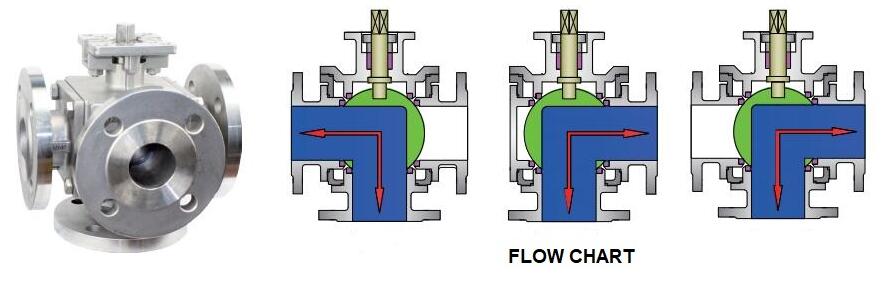
1 Installation Precautions
Before installation, inspect the Four way ball valve appearance, sealing surface and flow channel for damage and impurities, and verify that the valve specifications, pressure grade and material match the working conditions. Clean welding slag, rust and debris inside the pipeline to avoid scratching the sealing surface. The Four way ball valve can be installed at any angle with no medium flow direction restriction, suitable for horizontal and vertical pipelines. For flange installation, fasten bolts evenly to prevent valve body deformation and sealing leakage caused by uneven stress. After installing the driving mechanism, commission the limit and opening to ensure accurate 90-degree rotation without jamming or over-travel.
2 Daily Maintenance
Regularly inspect the sealing performance of the Four way ball valve body and valve stem to check for internal and external leakage risks under conventional working conditions. Clean flow channel impurities regularly to avoid sealing surface wear caused by particle accumulation. Add lubricating grease periodically for manual and worm gear transmission valves to ensure flexible opening and closing. Inspect the circuit, air source pipeline and actuator operation status of electric and pneumatic valves regularly to guarantee accurate automatic control. For long-term idle valves, maintain a half-open state to prevent permanent deformation of the sealing surface caused by long-term compression, and store them in a dry and ventilated environment with anti-corrosion protection.
3 Common Faults & Solutions
Slight leakage: Mostly caused by impurities trapped on the sealing surface, which can be eliminated by opening and closing the valve several times to flush impurities.
Opening and closing jamming: Caused by insufficient lubrication or actuator limit deviation, solved by supplementary lubrication and limit calibration.
External leakage: Mainly due to aging packing, which can be completely repaired by replacing the packing sealing assembly. The valve features extremely low overall failure rate with simple and low-cost operation and maintenance.
1. Confirm working condition parameters: Clarify medium type, temperature, pressure and flow rate, and select matching valve material, sealing type and pressure grade. Choose stainless steel for corrosive media and hard seal structure for high temperature and high pressure working conditions.
2. Determine flow channel type: Select X-type flow channel for bidirectional circulation and cross commutation working conditions; select L-type flow channel for pipeline switching and flow diversion scenarios.
3. Match driving mode: Choose manual type for low-frequency on-site operation; pneumatic type for explosion-proof and fast switching requirements; electric type for remote automatic control; hydraulic type for large-caliber and ultra-high pressure working conditions.
4. Select connection mode: Adopt flange connection for conventional medium and large-caliber pipelines; thread connection for precision small-bore pipelines; welding connection for high-pressure industrial pipelines.
BQ41F BQ41PPL Jacketed Ball Valve
BQ41H BQ41Y Jacketed ball valve
Pneumatic ceramic lined Y type ball valve
3 Way ceramic lined Y type ball valve
Y type 135 degree ceramic lined ball valve
Y pattern 120 degree ball valve
Y pattern 135 degree ball valve
SHANGHAI HUIXUAN VALVE
Mobile:+86-17717520739
Wechat:17717520739
Email:info@shxvalve.com
Address: NO.720, Suide Road, Jiading District,Shanghai, China.



 微信扫一扫 添加我为好友了解更多  |